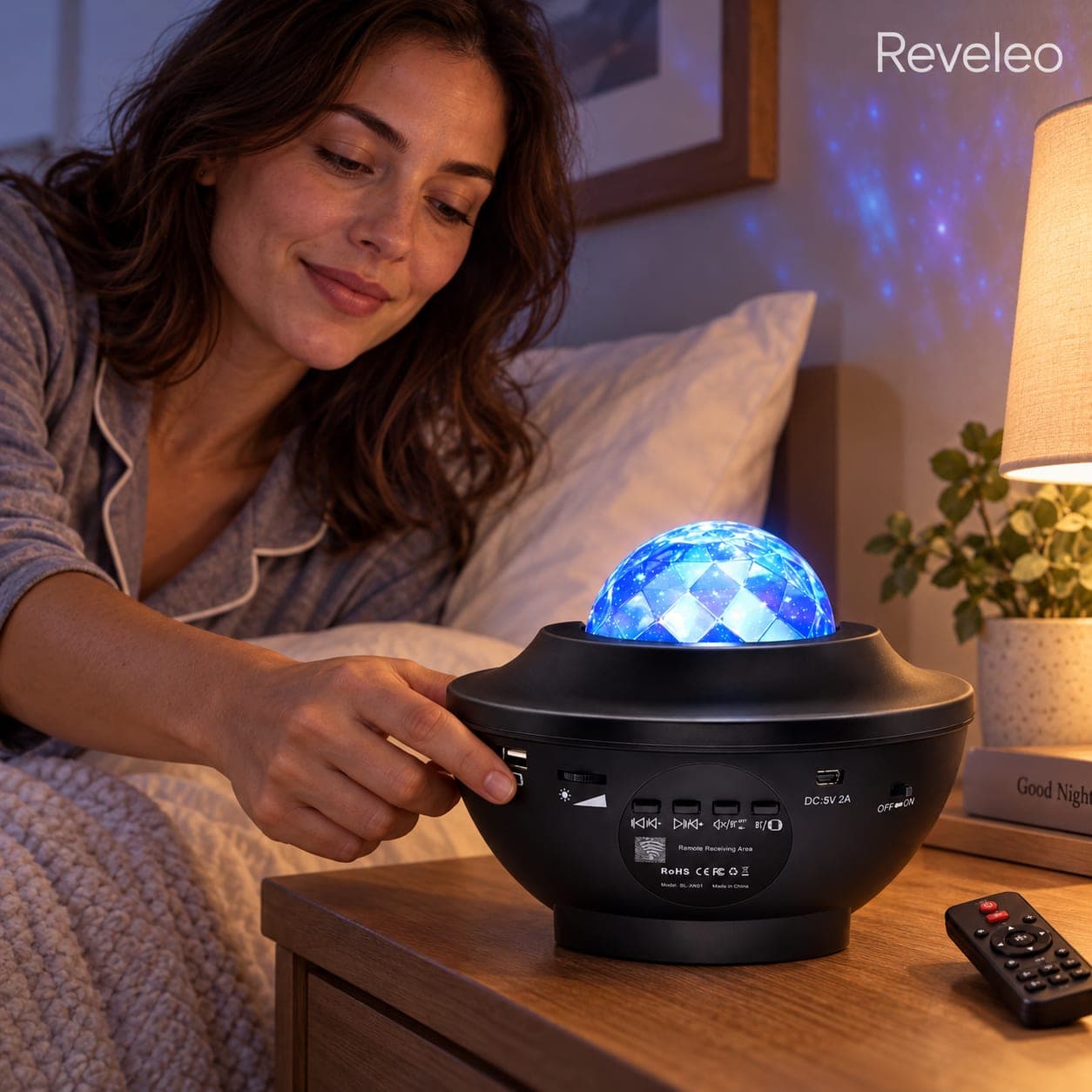
Illustrative image
Reveleo
Galaxy and star projector with remote and timer
Get it between Tuesday 10 November and Thursday 12 November
No card: you pay the courier in cash.
Sold by Extrapy · Pay on delivery · WhatsApp
By law: 14 days to return your order · 3-year legal guarantee
What it does
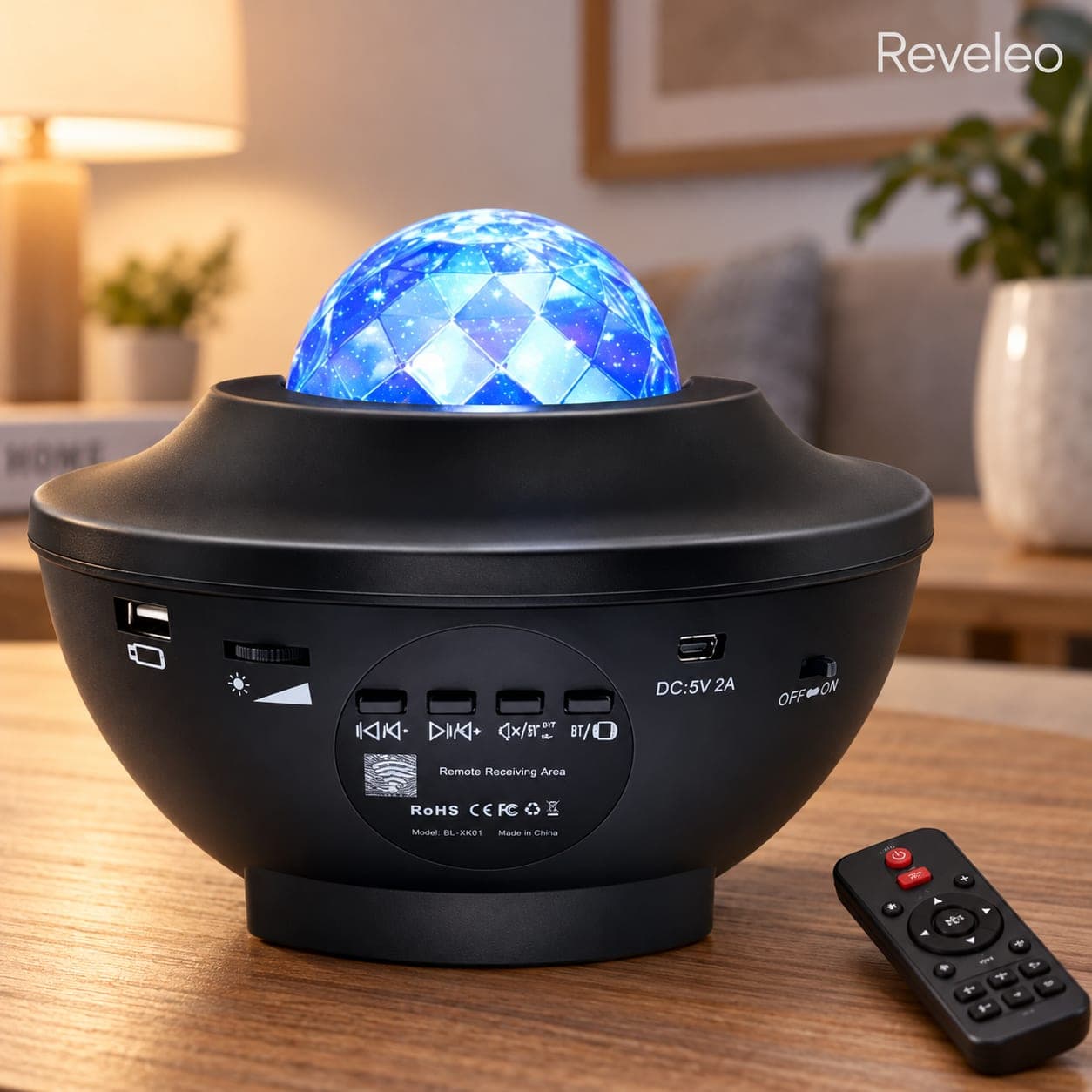
A galaxy and star projector lamp that fills the ceiling and walls with moving coloured nebulae and points of light. With the remote control you change the colour mode, adjust the brightness and set the switch-off timer. Ambient lighting for a bedroom, a children's room or a film night.
Specifications
| Product type | Galaxy and star projector lamp |
|---|---|
| Materials | Plastic housing; clear plastic lens |
| Dimensions | Approx. 12 × 12 × 14 cm |
| Weight | Approx. 350 g |
| Light modes | 8 colour modes; brightness adjustable in 3 levels; nebula and stars together or separately |
| Timer | Automatic switch-off after 1 or 2 hours |
| Power and compatibility | 5 V USB cable included; compatible with any USB charger or port; power adapter not included |
| Remote control | Infrared; runs on 2 AAA batteries, not included |
| Colour | White |
| Guarantee | 3-year legal guarantee |
What's in the box
- Reveleo projector
- Remote control
- USB power cable
- Instruction manual
Read the full description
Reveleo is a galaxy and star projector: a small lamp that, instead of lighting the room, projects slowly moving patches of colour, like nebulae, and points of light that act as stars onto the ceiling and walls. It is ambient lighting for anyone who wants to change the look of a bedroom, decorate a children's room or accompany a film or a gaming session with something more than the usual lamp.
A star projector for ceilings and walls
The effect has two layers. The nebula is a diffuse coloured light that drifts and changes shape slowly. On top of it, the stars appear as sharp points. Together they cover a good part of the ceiling and run down the walls; the farther the projector is from the surface, the larger and fainter the projection looks.
A galaxy projector lamp with colour modes and adjustable brightness
The colour modes change the tone of the nebula: you can leave a fixed colour or a combination that keeps shifting. The brightness is adjustable too, so the same projector works as a discreet backdrop while you watch a series or as the main feature with every other light off. The specific modes of this model are in the specifications table.
A star projector with remote control and timer
The remote control brings every function together: switching on and off, changing mode, raising or lowering the brightness and setting the timer. With the timer you choose how long you want it to stay on and, when the time is up, it switches itself off, so it does not keep running all night if you forget.
For the bedroom, a children's room or a film night
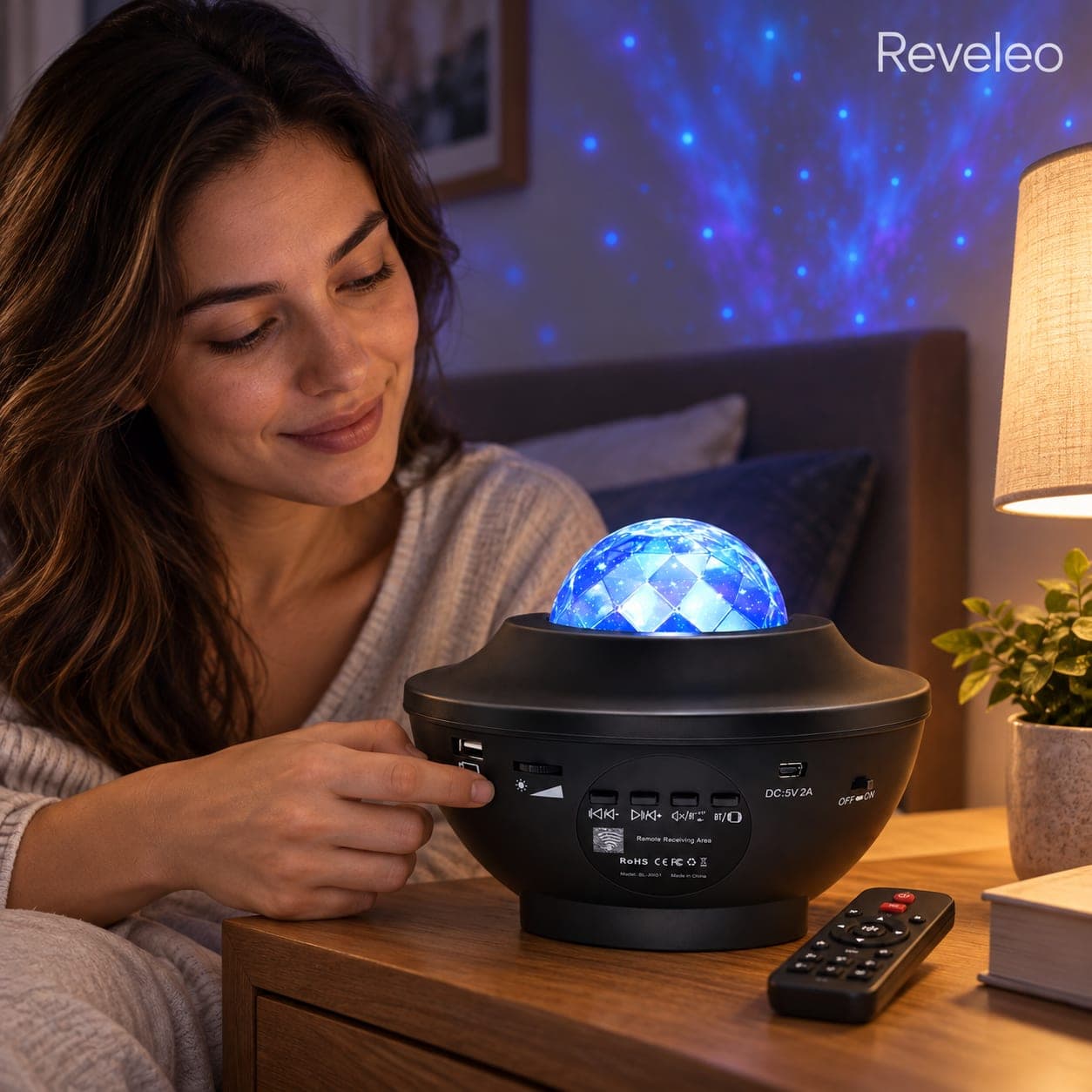
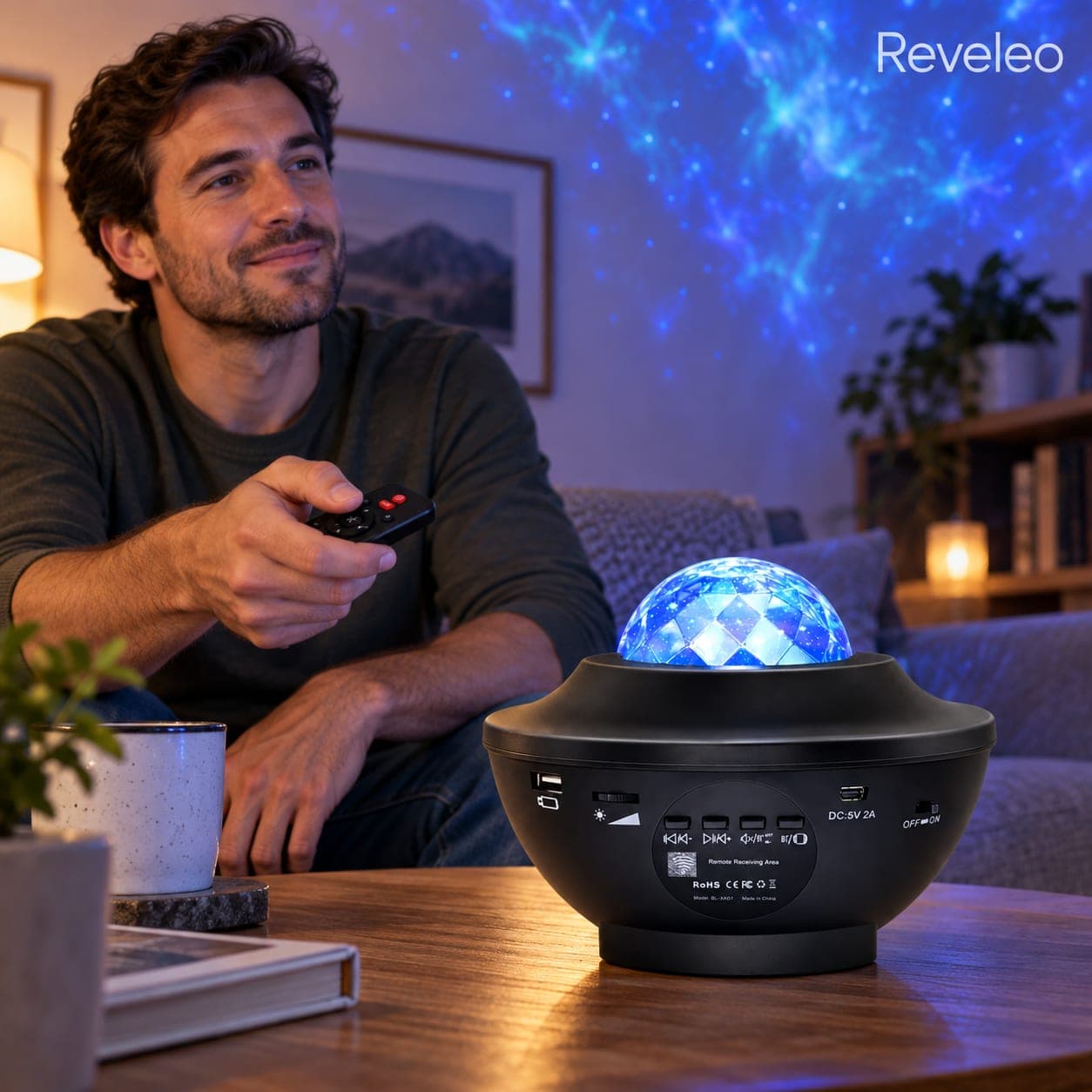
In the bedroom it works as decorative lighting with the other lamps off. In a children's room it turns the ceiling into a sky of colours; place it where they cannot reach it, because it is a decorative lamp and not a toy. In the living room, with the brightness turned down, it accompanies a film, a dinner or a music session without competing with the screen.
How to use it and where to place it
Find the spot
Put it on a bedside table, a shelf or the floor, on a stable surface, pointing at the ceiling or at a plain, light-coloured wall.
Connect it
Plug in the power cable and switch the projector on. Get the remote ready as described in the manual.
Turn off the other lights
The less light there is in the room, the better the projection looks.
Choose mode and brightness
Try the colour modes with the remote and adjust the brightness to your liking.
Set the switch-off
If you want it to turn itself off, activate the timer before putting the remote down.
Cleaning and care
- Unplug it before cleaning.
- Dust the housing and the lens with a soft, dry cloth; dust or fingerprints on the lens make the stars look blurred.
- Do not use water, alcohol or glass cleaner on the lens.
- Do not cover the projector while it is on, and keep it away from damp.
Frequently asked questions
Where should a star projector be placed?
On a stable surface such as a bedside table, a shelf or the floor, pointing at the ceiling or at a plain, light-coloured wall. The farther it is from the surface, the larger and fainter the projection will be. Avoid putting it where someone could look straight into the lens, for example at eye level beside the bed.
Can you see it with the lights on or during the day?
The less light there is, the better it looks. With lamps on or daylight coming through the window, the nebula loses colour and the stars can hardly be made out. To enjoy it properly, lower the blinds or use it at night with the other lights off or very dim.
Is it suitable as a star projector for a children's room?
As a decorative lamp, yes: it fills the ceiling with colours and stars. Bear in mind that it is not a toy. Place it out of children's reach, on a tall piece of furniture, stop them from looking closely into the lens and keep the remote and its batteries where they cannot get at them. The timer lets it switch itself off.
How does the timer work?
You activate it from the remote control. You choose one of the available times and, when it is up, the projector switches itself off without you having to do anything. If you do not activate it, it stays on until you turn it off yourself. The times this model offers are shown in the specifications table.
Does it run on batteries or does it need to be plugged in?
The projector is powered through its cable, connected to a charger or a port with sufficient output, so it is best placed near a socket. The remote control does take batteries. The specifications table shows the type of connection and the batteries the remote needs.
Are the stars real constellations?
No. It is a decorative effect: the points of light are scattered to give the feel of a starry sky, but they do not reproduce the real position of the stars or the constellations. If you want to learn to recognise the night sky, you need a planetarium with constellation discs, which is a different kind of device.